
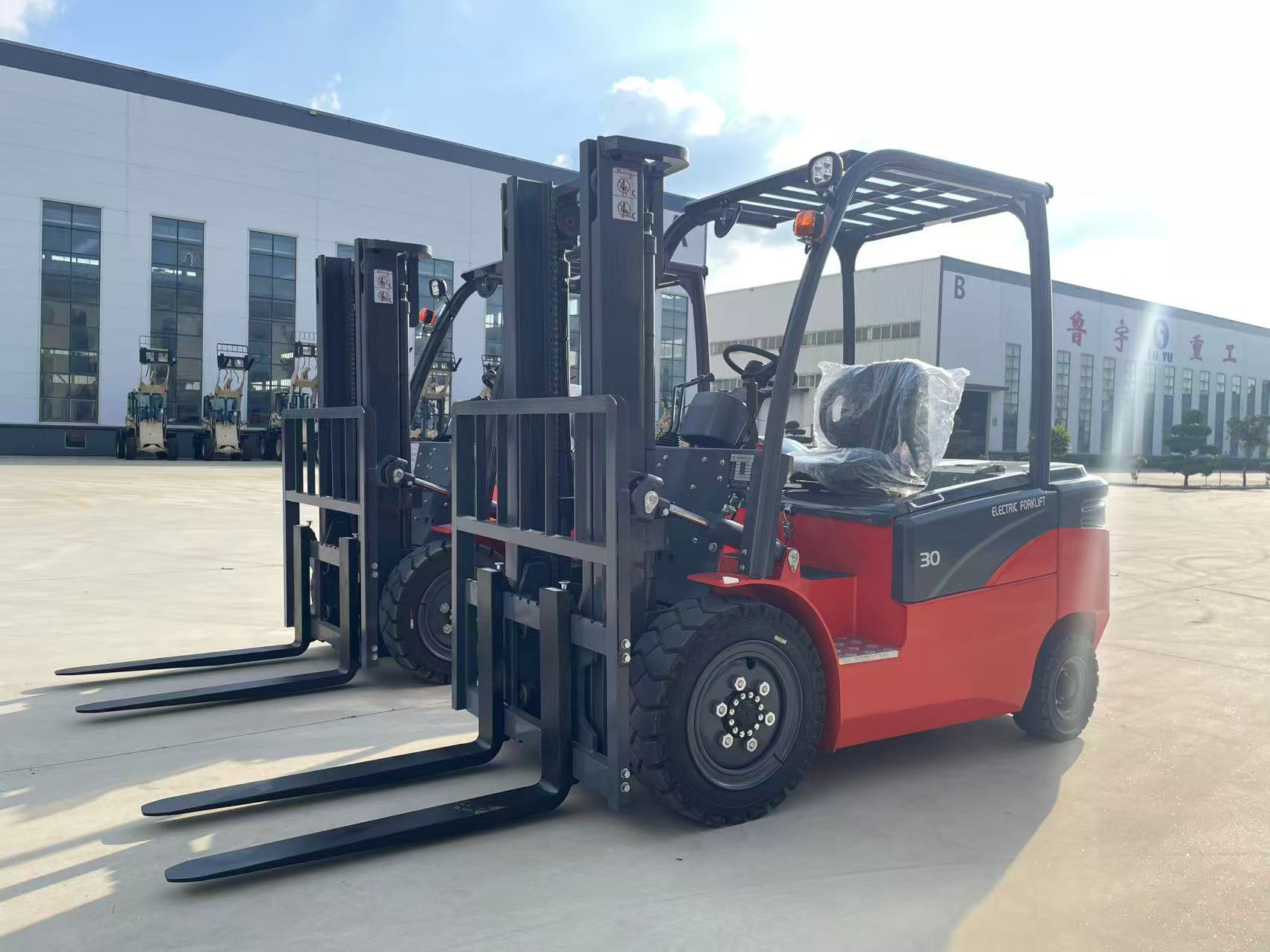
There are many types of forklifts, but their basic structures are similar. They are mainly composed of an engine, chassis (travel mechanism), body, lifting mechanism, hydraulic system and electrical equipment. The engine is the power source of the internal combustion forklift. It converts the heat energy generated by the fuel into mechanical energy and outputs power to the outside through the engine flywheel. The chassis is used to support the body, receive the power output by the engine, and ensure that the forklift can run normally. It includes the transmission device, travel device, steering device and braking device. The body and frame are integrated and welded together from steel profiles. The cast iron block at the rear of the forklift, which is adapted to the model, serves as a counterweight. Its weight is determined according to the rated lifting capacity of the forklift. It plays a balancing role when the forklift is loaded to maintain the stability of the forklift. The lifting mechanism is mainly composed of the mast and forks. The mast is hinged to the front axle support body and consists of a set of parallel steel frames and a sliding bracket for fixing the forks [5]. Forklifts use a combination of hydraulic systems, pulley systems, and control units to lift heavy objects over varying distances. The main components enabling a forklift’s operation are the hydraulic system, chain drive system, and forklift control units. Other key components include the load backrest, overhead guard, cargo box, forks, mast, power source, frame, and tires.
The forklift’s hydraulic system uses a series of cylinders, pistons, and fluid to efficiently lift and lower loads. The operator pushes the lifting handle to activate the pump, which forces fluid into the hydraulic cylinders. The increased pressure pushes the pistons, thereby lifting the mast and forks. The forklift’s roller sprocket system connects the forks to the frame via roller chains. Gears at the top of the mast press against the roller chains; when the hydraulic piston pushes the mast upwards, the gears drive the chain, pulling the forks upwards. This design allows for higher and more stable lifting compared to relying solely on a hydraulic system. The forklift control units include steering and lifting controls. The forklift uses rear-wheel steering for improved accuracy and rotational control when carrying a load. Lifting controls use a lever to move the load up and down, and another lever to tilt the load forward and backward.
Post time: Apr-07-2026